
A Women in Medicine Participatory Poem
A Model for Engagement, Connection, and Advocacy
Abstract
To commemorate Women in Medicine Month, we created a first-of-its-kind participatory poem involving faculty, staff, trainees, and students, at an academic medical center. Responses to prompts were collected both online and through an in-person writing studio. Words and phrases from these responses were then curated into an original poem created for the commemoration. The resulting poem has become a model of community made art that fosters engagement and community. Moreover, the method by which the poem was produced and its subject support avenues for innovation in medical humanities and the arts at an academic medical setting and for advocacy using community made art.
Article
I have witnessed the increasing presence of women in the formal spheres of medicine firsthand. My mother attended medical school in Tehran, Iran in the late 1960s. Approximately 10% of her classmates were women. In 1974, she was the second woman to graduate from the Obstetrics and Gynecology Residency at Tufts University. As a child, I spent Saturdays with her while she saw patients in clinic, rounded on the ward, or performed circumcisions. Watching her olive toned hands fold into exam gloves was a norm. By 1996, the year I matriculated into medical school, women made up 42.6% of medical school enrollees.1 Currently, they make up over 50%.1
The presence of women in modern medicine was hard-fought and is significant beyond being a better reflection of the society it serves.2 My mother recounted how she overheard some of her male co-residents disparage her female resident predecessor, who became a respected gynecologic oncologist. Yet she also described how her female patients would share a pertinent aspect of their medical history for the first time, with her, because she was a female physician. And the patients who were believed for the first time when under her care, and because of that, were diagnosed accurately. It was no accident that my pediatrician was a black female physician. I sensed the pride flowing between my mother and her during my well-child visits, as her hands examined my abdomen and her warm demeanor met my giggles. For me, it was normal that hands that healed were of many colors, and female.
At the same time in Iran, where my mother grew up, where she danced to the Beatles and wore miniskirts, women were losing their freedoms, including the way they dressed, travelled, and learned. Defying the oppression resulted in injury, incarceration, torture, or death. Despite this, or perhaps even more because of it, my mother reminded me of a teaching in our Bahá’í Faith. That men and women can be regarded as wings of a bird and that the bird of humanity cannot fly unless both wings are strong.3
The experiences of women in medicine, the knowledge that values and freedoms can be lost, and the impact of words and metaphor have shaped my path in medicine and writing. Words, just as medications and interventions, are a vital medium of healing. As Ursula K. Le Guin observes: “Words are events, they do things, change things. They transform both speaker and hearer; they feed energy back and forth and amplify it. They feed understanding or emotion back and forth and amplify it.”4 We’ve turned more attention to the power of words and narrative in medical education and health care over the last twenty-five years. Narrative Medicine and Medical Humanities programs have found homes in medical schools across the country.5,6 Many of us have learned to look for the patient’s story, their symptoms and the meaning ascribed to and interrogated because of them. Knowing this story can illuminate a patient’s motivations, values, interpersonal and social context, and our own in relation to them, supporting better health care. When the story’s significant points are brought together, like plot points in a narrative, we arrive at the denouement of a diagnosis and a plan to address it.
Yet, there are instances in which words molded into poetry reflect and communicate more effectively.7 Poetry lives beyond the traditional linear narrative form. It advances our understanding of a patient’s and our own experiences unbound by the forward momentum of narrative. Poems linger in moments and emotions. And they may more accurately reflect the way we learn about symptoms, ourselves, and how we interact with one another, in scattered phrases, brief scenes, questions, line breaks, swallowed emotions, and sudden epiphanies. Poetry moves between and beneath plot points of illness and story toward the rhythm and melody of what and whom we care deeply about. Poems hum of the human who carries the body before us, and sing of the life that beats the hearts in us.
We sought to apply participatory poetry in commemorating Women in Medicine Month in order to distill and concentrate the experiences of women in medicine, amid accelerating threats to women’s rights. In 1948, the physician and poet William Carlos Williams called for a revolution in how we approach the measure of poetry noting that “What we are trying to do is not only to disengage the elements of a measure but to seek a new measure…that will be commensurate with the social, economic world in which we are living.” 8 Past structures of poetry, he explained, were barriers to expression in his time and new forms were needed to “let our feeling through.” His poems represented a new way of writing poetry, in both form and subject. In the nearly eighty years since that lecture, our social and economic world has transformed exponentially, with rapid changes in technology, the structure of health care delivery, and the information landscape shaking the foundations of what it means to be a physician and a patient. Akin to the way Dr. Williams argued for a new measure of poetry, participatory poetry imagines a new language of poetry to represent a chorus of voices, just as collage art collects and reimagines pieces into a singular new work of art.
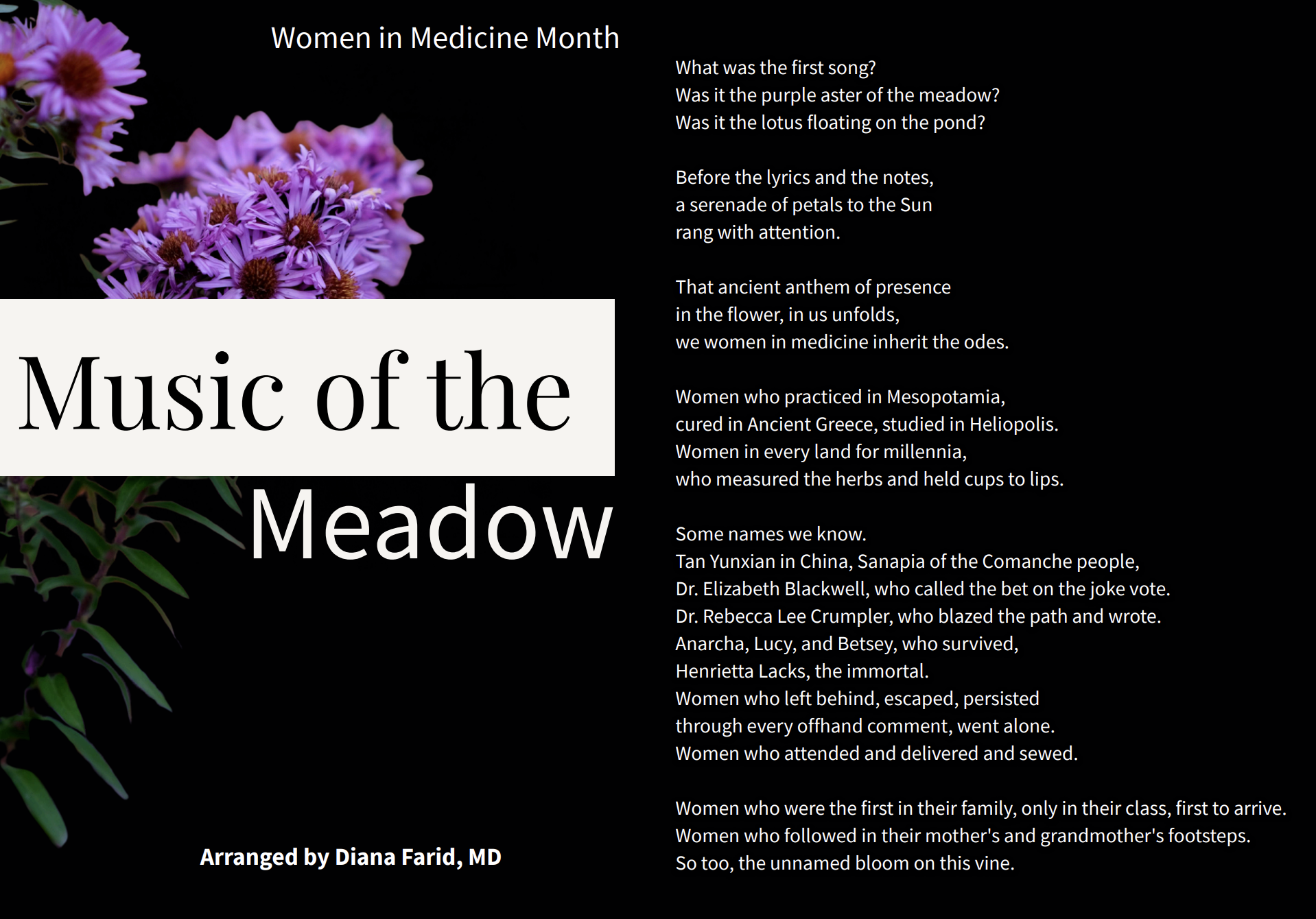
We distributed prompts to School of Medicine faculty, students, and staff, inviting their participation. Through an in-person writing studio and online submissions, 27 submissions were received. Participants provided written permission to include their responses in the poem. Each submission is represented in the poem, through extracted words or phrases from the responses, around which the curator [DF] created an original poem titled “Music of the Meadow” — which follows. The curated words are italicized to show the community’s contribution and pivotal role it played in the creation of this participatory art.
We hope this project can serve as a model for creating art in an academic medical setting and a proof of concept of how participatory poetry can foster reflection, create connection, and support advocacy. But, as Margaret Renkl asks, “What can something so small as a poem possibly do to save us now? The answer lies in poetry’s great intimacy, its invitation to breathe together. We read a poem, and we take a breath each time the poet takes a breath. We read a nature poem, and we take a breath with the trees. When the trees — and the birds and the clouds and the ants and even the bats and the rat snakes — become a part of us, too, maybe that’s when we will finally begin to care enough to save them.” Maybe that’s when we will finally, also, begin to care enough about saving one another, to realize the power in both of humanity’s wings, and the magnificent flight possible before us.
References
- Barzansky B, Walker F. MD-Granting Medical Schools in the US, 2024-2025. JAMA. Nov 4 2025;334(17):1565-1571. doi:10.1001/jama.2025.13928
- Joseph MM, Ahasic AM, Clark J, Templeton K. State of Women in Medicine: History, Challenges, and the Benefits of a Diverse Workforce. Pediatrics. Sep 1 2021;148(Suppl 2)doi:10.1542/peds.2021-051440C
- ʻAbduʼl B, MacNutt H. The promulgation of universal peace : talks. 2nd ed. Baháʼí Pub. Trust; 1982:xx, 513 p.
- Le Guin UK. The wave in the mind : talks and essays on the writer, the reader, and the imagination. 1st ed. Shambhala ; Distributed in the United States by Random House; 2004:x, 304 p.
- Charon R. The patient-physician relationship. Narrative medicine: a model for empathy, reflection, profession, and trust. JAMA. Oct 17 2001;286(15):1897-902. doi:10.1001/jama.286.15.1897
- Anil J, Cunningham P, Dine CJ, Swain A, DeLisser HM. The medical humanities at United States medical schools: a mixed method analysis of publicly assessable information on 31 schools. BMC Med Educ. Sep 1 2023;23(1):620. doi:10.1186/s12909-023-04564-y
- Glausiusz J. Engaging the head and the heart: why scientists turn to poetry. Nature. Apr 2026;652(8109):527-528. doi:10.1038/d41586-026-01028-3
- Williams WC. The Poem as a Field of Action. Poetry Magazine2009.
- Renkl M. How to Breathe With the Trees. The New York Times. April 1. Accessed 4/10/2026. https://www.nytimes.com/2024/04/01/opinion/ada-limon-poet-nature.html